Showing posts with label RHEV. Show all posts

Thursday, January 19, 2012

RHEV 3 vs Vsphere 5 0

SkyHi @ Thursday, January 19, 2012
Some days ago Red Hat has announced the availability of its Red Hat Enterprise Virtualization (RHEV) 3.0 public beta. The first beta of RHEV 3.0 was announced in August, but was not available to the general public. You needed to have an active RHEV subscription at that time. The evaluation is immediately available to anyone with a Red Hat Network account.
About the new features and the improvements there is a specific page on RedHat site. Red Hat Enterprise Virtualization 3.0 includes updates such as:
  • Red Hat Enterprise Virtualization Manager is now a Java application running on JBoss Enterprise Application Platform on Red Hat Enterprise Linux. Was silly that first versions of this products required a Windows Server to run.
  • A power user portal that provides end users with a self-service interface to provision virtual machines, define templates and administer their own environments.
  • Extended multi-level administrative capabilities, allowing fine-grained resource control, Role Based Access control, delegation and hierarchical management.
  • An integrated and embedded reporting engine allowing for analysis of historic usage trends and utilization reports.
So the features of the Virtualization Manager are now similar of the core features of VMware vCenter Server (from the first releases).
About the hypervisor layer, KVM introduce new capabilities focused around scalability, performance and security. With the limits described in the previous post, we can try to compare some hypervisor features between the RHEV beta and the current vSphere version:
RHEV 3.0vSphere 5.0
Max cores per host160 cores160 cores
Max RAM per host2 TB2 TB
Max vCPU per VM64  vCPU32 vCPU
Max vRAM per VM512 GB1 TB 
Other hypervisor features:
  • Transparant Huge Pages: New feature where the Linux kernel dynamically creates large memory pages (2MB -vs- 4KB) for virtual machines, improving performance by reducing the number of times that memory is accessed, typically improving performance for most workloads. This feature exist in ESXi from several versions.
  • SELinux: because the KVM is a Linux kernel hypervisor, SELinux framework can be use to hardening the hypervisor.
On the performance side, some benchmarks (Red Hat Enterprise Virtualization crushes the competition) try to demonstrate that the open source KVM hypervisor leads the industry in overall performance and scale-up as measured by the SPECvirt industry-standard virtualization benchmark.
hyper-v-3-vs-vsphere-5
A few days ago appeared on the site VKernel an article that compares the current vSphere 5 with the next Hyper-V. The title is quite explanatory: Hyper-V 3.0: Closing the Gap With vSphere 5 .
One wonders whether the article was prepared before or after the acquisition of Quest, but in the end it does not matter ... it is still an analysis of products that are not really omegenei, at least not from the point of view temporaire (the new version Microsoft Hyper-V is not released yet). When 3 Hyper-V will be released will talk about his upcoming confrontation with the vSphere.
There remain, however, the raw data showing that, on paper the two products are approaching the level of the hypervisor functions:
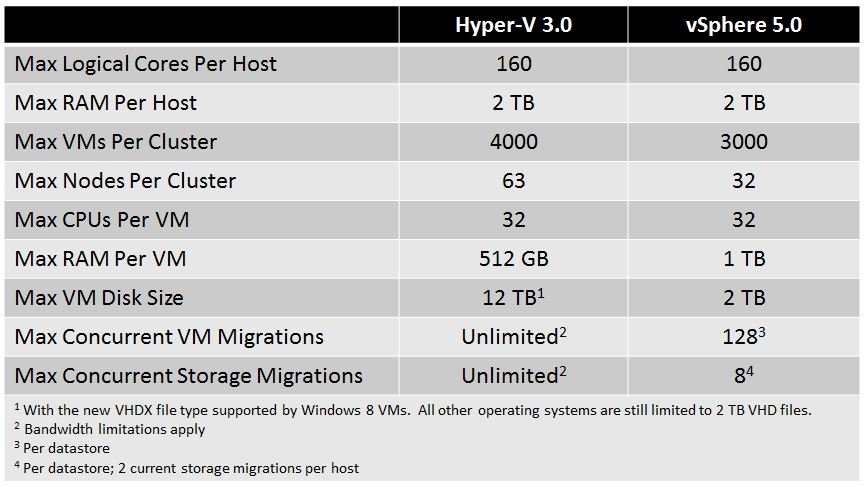
Other features that are expected (or at least declared) in Hyper-V 3.0 are:
  • Ability to live migrate a VM that is the state of his records (in fact the equivalent of a VMotion + Storage VMotion).
  • Live migrate VMs without shared storage.
  • Networking completely revised with the possibility of third-party virtual switches (Already Implementing Partners Microsoft Hyper-V Virtual Switch 3 ).
  • The storage medium of type NAS CIFS, SMB, NFS (also referred to can support nfs4).
Since Hyper-V will also be available desktop side (but you have to do with what versions of Windows 8) could be some form of migration (almost certainly cold) even between desktops and servers. But basically Workstation 8 already does today.
But perhaps the most interesting data, as also written in the article by VKernel, will be those related to performance: in August, VMware showed a performance study conducted by third parties , which showed that vSphere 5.0 was 20% faster than Hyper V-2.0. We must see the data between 3 and Hyper-V version of vSphere next year (likely date of issue of the new Windows family).

Thursday, June 17, 2010

Red Hat Enterprise Virtualization (RHEV)

SkyHi @ Thursday, June 17, 2010

Disclaimer : Warix Technologies is one of the partner for Red Hat Enterprise Virtualization in Malaysia and I am a Fedora Ambassador. I have tested the late BETA of RHEV for a few days.


So Red Hat had already released their new and shiny Red Hat Enterprise Virtualization or RHEV in short, a few hours ago. This release, is one of the key milestone for RHEV after being officially announced in February 2009. So what this really means?


Virtualization is not something new, in fact its already nearly 50 years since IBM put their Virtualization solutions in their mainframe (and still is doing so on their System Z). But lately the surge of Virtualization hits new heights the last couple of years in the x86 market due to one factor, VMware.


Shortly after releasing their VMware workstation to the market in 1999 for the workstation and desktop market, VMware realized in order to be a big hit, it needs to play in the datacenter. So they start to focus their efforts to ensure their solution works reliably on the greatest of workloads and datacenters.


The Open Source Community picks up the fever soon after with the Xen Project in 2002. Xen the project and XenSource the company fuels the new technological goldmine and became for a while, the de facto standard. Citrix realized this and bought Xen for USD500 Million soon after.


Red Hat, Novell and other Open Source vendors jumps into the Xen fever and introduced it to the world circa 2006-2007 until now but hardly makes a dent into the VMware market either through lack of marketing, less features and I think most important of all IMHO – Manageability.


Around early 2007, enters KVM from Qumranet which turns Linux into a Hypervisor. But thats not all, they even build a user friendly web management interface that can manage big numbers of virtual machine, though mostly for Virtual Desktop Infrastructre (VDI) or desktop virtualization. Red Hat then acquired Qumranet and move the direction of the software to also manage the servers.


Enough of the history lesson, so basically RHEV have 4 components which are:-


  1. RHEV-M for Server (or Management Interface for Server) – This is basically the web-based GUI interface for RHEV solutions with ability to manage hundreds and thousands of server using its unique search-driven interface. This is the equivalent of Virtual Center of VMware.
  2. RHEV-M for Desktop (or Management Interface for Desktop) – Same with above but to manage your VDI Infrastructure. Also includes user portal for user to access their VDI. Release TBA.
  3. RHEV-H (RHEV Hypervisor Baremetal) – The baremetal Hypervisor based on the same code with RHEL 5.4 with less flexibility but easier installation for Non-Linux Admin / User. It can also be installed on USB disk, memory cards on CD.
  4. Red Hat Enterprise Linux (RHEL) 5.4 with KVM support – The vanilla RHEL that we know and love (or CentOS for some of you) with KVM and RHEV management support. This basically means you can hook-up your RHEL into the RHEV-M to manage your servers.

So what’s great about all this RHEV stuff?


  1. KVM – Yes that is single biggest thing in KVM that will be the game changer. Unlike Xen, the application compatibility betwen Linux in Baremetal and Linux in Virtual environment is gone as the 2 share the same code base. So whatever runs in baremetal, will run under KVM without any modification. This will ensure compatibility between binaries and ensure less headache to software vendors to create version specialized for VM environments.
  2. Manageability – Virt Manager to manage big numbers of VMs? With all due respect, NO. Enter RHEV-M. The one massive advantage that VMware had over other Open Source Virtualization vendors will be no more soonish. RHEV-M enables administrators to manage their Virtual infrastructures without knowing the command line that Linux is famous for. Its point and clickfest all over on their favourite Internet Explorer’s .. yes IE and that one will be talked about later :p
  3. Open Source – When talking about Open Source, there’s 2 great things. 1 is the cost factor and no 2 is the features factor. The offerings from Redhat is cheap compared to its competitors (USD499 for standard and USD7xx for premium per socket) and the features will keep on coming (libvirt, SRIOV, Libguestfs etc) when you subscribe to RHEV due to active community around KVM and its companion.
  4. Memory and Storage Overcommit – Thanks to QCOW or Thin Provisioning and KSM or memory page paging, its now possible to allocate more memory (RAM) to your server up to 150% and same applies to your storage (though maybe not 150%).
  5. Paravirt Drivers – RHEL 4.8 (and above) and RHEL 5.3 (and above) automatically accelerated with VirtIO Paravirt Drivers that will boost the performance of the VM to near native. For Windows, the paravirt drivers is WHQL certified and will be delivered through Windows Update. Cool rite? Thats what you get when you in bed with the devil!

What is NOT so great about it?


  1. M$ - The biggest issue about RHEV (and most controversial) is you have to run the management web interface on Windows Server. Yes its not a typo. And its also needs to have (take a breath) MS SQL, Windows Presentation Foundation, Active Directory, Windows POWERSHELL and also ONLY supports Internet Exploder.. opps I mean Explorer 6,7 and 8. And NO you cannot run it on Mono or Wine or Crossover for all the stuff above. But on the other hand, the potential customer might even be OK with it as they already have their Windows Infrastructure in their organization.
  2. Scripting – You can now do scripting to your RHEV, but only supports POWERSHELL!! no bash for you for now, though the VMware guys might be OK with it as VMware also supports powershell.
  3. I cant think of any more major roadblock, So just a placeholder if I remember any.

All in all, RHEV is a solid initial product, thanks to Redhat, Qumranet, Open Source Model and all the communities. This is what I call the power of participation. Although they are certain things that doesnt appeal for purist and Open Source community, I think Redhat have explored all the possibilities and thinks this the right way to go for now.


The new version (which will be RHEV 3, the current is RHEV 2.1) which targeted by middle of next year will runs on JBoss and Hibernate (which means you can hook it to almost all database) which should make everyone happy except VMware off course.